How a Reading Summary Printable Template Transforms the Way Professionals Absorb and Retain Knowledge
Knowledge work demands a steady stream of input. Books, reports, industry briefs, white papers, long-form journalism, and dense email newsletters compete for attention every single day. Yet the bottleneck is rarely how much you read. The bottleneck is how much you remember, synthesize, and actually apply. A Reading Summary Printable Template addresses this exact friction point, turning passive scanning into an active, structured ritual that leaves you with something durable. For students, it is a study cornerstone. For entrepreneurs, marketers, and creatives, it is a lightweight system that protects the hours invested in reading from evaporating the moment the page turns.
What a Reading Summary Printable Template Actually Is
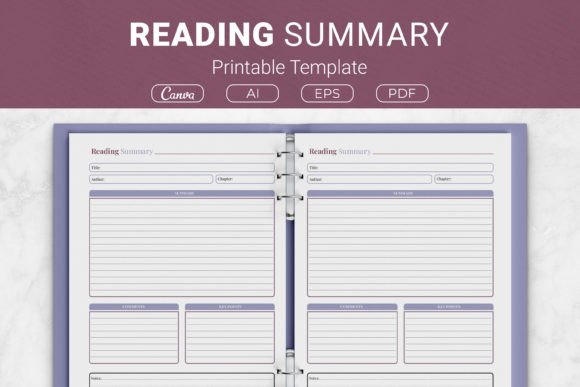
At its core, a Reading Summary Printable Template is a pre-structured sheet that guides you through capturing the essential metadata and intellectual payload of anything you read. You fill in the title, author, and chapter or section, then move through prompts for a brief summary, key points, personal comments, and actionable notes. It sounds simple, and that is exactly the point. The simplicity is what prevents the tool from becoming another chore. The layout removes decision fatigue so your mental energy goes entirely into engaging with the material.
The best versions, designed for formats like US Letter and A4, include dedicated fields that nudge you toward different levels of thinking. The summary section asks for synthesis. The key points section asks for prioritization. The comments section invites critical reaction. The notes section captures what you intend to keep. Together, these fields mirror how a well-trained mind processes information naturally but with a consistency that raw memory alone cannot sustain.
Why Structured Reading Capture Matters in a Distracted Economy
Attention has become the scarcest professional resource. People spend hours consuming books, courses, and long articles, yet weeks later struggle to reconstruct the central argument. The root issue is not the quality of the material but the absence of a lightweight retrieval framework. A Reading Summary Printable Template steps into that gap by making capture almost frictionless. You are not drafting a formal book report. You are jotting down the minimum viable insight needed to reactivate the knowledge later.
This matters because the half-life of unrecorded information is brutally short. Without a nudge, the brain prunes what it deems unused. A filled template, tucked into a binder or stored digitally, becomes an external retrieval cue. Months later, flipping through a stack of completed summaries brings entire books back to mind in minutes. For content creators, strategists, and consultants who need to reference ideas across projects, that external memory bank shifts from being a nice-to-have to a competitive advantage.
The Shift from Digital Overload to Intentional Analog Capture
For years, the prevailing narrative pushed everything toward apps, cloud notes, and digital highlighters. The pendulum is swinging back, not toward rejecting technology, but toward recognizing when analog tools create a better cognitive environment. Writing by hand on a printed sheet slows you down just enough to engage different neural pathways. A Reading Summary Printable Template sits right in that sweet spot between digital efficiency and tactile retention.
Professionals who pair a Kindle or an audiobook with a printed summary sheet often discover they remember far more than when they rely solely on digital highlighting. The physical act of summarizing forces condensation. You have a finite box on the page, so you must choose the most important ideas. This constraint is a feature, not a bug. It replaces the hoarding mentality of digital note-taking—where everything gets saved and nothing gets prioritized—with editorial judgment.
How Creators and Marketers Use Summaries as Idea Feedstock
For freelance writers, content marketers, coaches, and course creators, reading is rarely purely for leisure. It is research and creative fuel. A well-maintained collection of reading summaries becomes a searchable idea bank. Need a statistic, a framework, or a counterintuitive example for an article or client presentation? Instead of re-reading entire chapters, you scan your summaries. The key points field in a Reading Summary Printable Template acts like a curated index of the author’s most potent insights, filtered through your own lens.
Consider a marketing strategist reading a book on behavioral economics. In the summary, they record not just what the author said but how the principle applies to landing page copy. That application note, captured in the comments or notes field while the idea is fresh, is worth far more than a generic highlight. Weeks later, during a campaign planning session, that note transforms directly into a tactic. The template becomes a bridge between abstract knowledge and concrete output.
Designing a Reading Habit That Compounds
Consistency compounds, but consistency requires a system that feels rewarding. A Reading Summary Printable Template turns completion into a tangible event. Finishing a chapter and filling out a sheet creates a small but genuine sense of progress. Over weeks and months, a growing stack of filled templates becomes visual proof of intellectual investment. That visual proof is surprisingly motivating, much like checking off boxes on a habit tracker.
This is especially valuable for people who read across multiple books simultaneously, a common pattern among entrepreneurs and curious generalists. Without a capture system, switching between books creates a blurry overlap where details from one text bleed into another. The discipline of summarizing each chapter or section before moving on creates a clean cognitive boundary. You close the loop on one chunk of material before shifting mental contexts, reducing interference and improving retention for each individual work.
Beyond Books: Unexpected Uses for the Template
While the tool is named around reading, its utility extends further than novels and nonfiction. Professionals repurpose a Reading Summary Printable Template for summarizing research papers, webinar recordings, conference talks, and detailed client briefs. The structure—title, source, summary, key points, comments, notes—maps perfectly onto almost any information-dense input. A UX researcher might use it to condense user interview transcripts. A B2B salesperson might fill one out after reviewing a prospect’s annual report before a discovery call.
This flexibility is why the template appeals to such a broad audience. It is not locked into a single use case. The fields are generic enough to accommodate literary analysis, technical documentation, business intelligence, and personal development all on the same underlying framework. What changes is the nature of what you write, not the process you follow. Standardizing the capture method across different types of material trains your brain to approach all information with the same structured curiosity.
The Quiet Productivity Trend Driving Interest
Interest in tools like a Reading Summary Printable Template is not happening in isolation. It connects to a broader quiet productivity movement that values depth over speed and retention over consumption volume. After years of speed-reading courses and book-a-day challenges, a growing number of thoughtful professionals are questioning whether racing through material actually delivers value. They are shifting toward slower, more deliberate engagement where finishing fewer books but retaining more from each is the goal.
This template fits that philosophy perfectly. It does not optimize for speed. It optimizes for understanding. The act of pausing at the end of a chapter to distill what you encountered signals a commitment to quality over quantity. In professional circles, especially among solopreneurs and small agency owners who must continually self-educate to stay relevant, this approach resonates because they feel the cost of forgotten information acutely. Every forgotten insight is a wasted hour.
Format Flexibility for Different Workflows
One reason the template has gained traction is that it does not force a single format or tool ecosystem on its users. Files arrive in AI Illustrator, EPS, and print-ready PDF formats, covering the needs of designers who want to tweak layouts and users who simply want to hit print. The inclusion of sizes like US Letter, A4, and the more portable 6x9 inches means the template fits different physical contexts, from a full desk binder to a compact notebook carried in a bag.
The Canva template link adds another layer of accessibility. Creators who live inside Canva for their content operations can customize colors, fonts, and branding without leaving their familiar environment. A coach might add their logo and use the customized version as a client resource. A book club might adjust the fields to match their discussion format. This adaptability means the template behaves less like a static product and more like a starting point for personal workflow design.
Practical Observations from Regular Use
People who adopt a Reading Summary Printable Template consistently report a few patterns after the first month. First, their tolerance for fluffy writing drops. Knowing you will need to extract key points from a chapter makes you far less patient with filler. You start gravitating toward denser, more substantive material because you can see the direct yield on the summary sheet. Second, conversations about what you are reading become sharper. Instead of vaguely describing a book as interesting, you can articulate the three main arguments and your take on each, because you have already done that cognitive work on the page.
Third, and perhaps most importantly, the habit changes how you read while you are reading. Active reading stops being a technique you know you should use and becomes a natural byproduct of your capture system. You find yourself mentally drafting key points as you go, identifying the author’s structure, and flagging passages that belong in the comments section. The template trains you into the mindset of an engaged reader, even on days when focus is hard to come by.
Connecting the Template to Larger Learning Trends
Lifelong learning has shifted from a nice-sounding aspiration to a professional necessity. The half-life of skills in marketing, technology, and creative fields keeps shrinking. This reality has fueled the growth of online courses, cohort-based programs, and intensive reading habits among ambitious professionals. But consumption infrastructure has lagged behind. People have more access to great material than ever before and fewer systems for internalizing it.
A Reading Summary Printable Template is part of a broader category of personal knowledge management tools that are filling this gap. Alongside digital tools like Notion and Obsidian, and analog methods like the Zettelkasten slip box, structured printable templates serve the user who wants integration—the best of paper and the best of digital. Scanned or photographed summaries can live in a cloud folder, tagged and searchable. The physical originals provide the kinesthetic benefits of handwriting. The combined approach creates redundancy and resilience in a personal knowledge system.
Who Benefits Most and Why
Students remain an obvious audience, particularly those in graduate programs where weekly reading loads are punishing and seminar participation depends on recalling arguments from dozens of papers. The template helps them walk into discussions prepared, with a stack of single-page references rather than a mountain of highlighted PDFs.
Book club members and avid readers find the template adds structure to conversations that might otherwise drift. Business owners who use books as a primary mode of continued education discover that their return on reading time improves sharply. Freelancers and creators who must turn what they read into content for their own audiences treat the template as the first draft of future newsletters, posts, or video scripts. In each case, the common thread is a need to move from passive consumption to active integration, and the template provides the bridge.
Making the Template Part of a Sustainable Routine
Sustainability matters. The most brilliantly designed template is useless if it sits in a drawer. What makes a Reading Summary Printable Template stick is its minimal viable effort. You are not writing an essay. You are spending five to ten minutes per chapter capturing what struck you. That short time investment feels manageable even on busy days, and the cumulative payoff keeps the motivation engine running.
Pairing the template with a consistent reading time, even just twenty minutes in the morning, creates a compound loop. Read, summarize, file. Over a year, a modest daily practice yields dozens or even hundreds of filled sheets, each one a durable artifact of intellectual effort. For professionals who bill for their thinking, that archive is a tangible asset.
In a culture saturated with content and starved for wisdom, tools that genuinely deepen engagement with ideas deserve attention. A well-designed Reading Summary Printable Template does more than save time. It preserves the value of the time you already spend reading, ensuring that what you learn today remains accessible when you need it tomorrow, next month, and for years to come.