Cannabis Review Log Book Template for Easy KDP Publishing
Imagine holding a beautifully structured, cleanly formatted log book in your hands — one designed specifically for documenting every nuance of your cannabis experience. That’s exactly what a well-made Cannabis Review Log Book Template delivers. Whether you’re a home grower meticulously tracking terpene profiles, a dispensary manager cataloging customer favorites, or a creative entrepreneur building a brand around strain education, this interior template transforms a simple notebook into a purposeful, data-rich journal. It’s not just a blank slate; it’s a guided framework that saves you hours of design time and gives you a professional resource ready to publish on Amazon KDP.
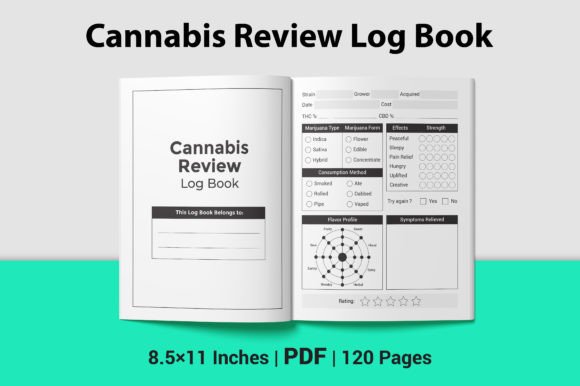
Many people start with a blank document and spend days fumbling with margins, alignment, and placeholder text, only to end up with a mediocre result. This template bypasses that frustration entirely. Because it’s been crafted with KDP specifications in mind, you get a no-bleed interior sized at 8.5×11 inches — the gold standard for journals and workbooks. The pages are crisp, high-resolution, and already formatted to print beautifully. You simply add your content, or keep the ready-made review prompts, and you’re minutes away from hitting the upload button.
A purpose-built interior that respects your workflow
The real strength of this template lies in its thoughtful layout. Each page invites you to record specific attributes: strain name, genetic lineage, aroma, flavor notes, THC/CBD percentages, consumption method, onset time, and a subjective rating scale. Instead of forcing you to scribble disparate notes on random scraps of paper, the structure creates a consistent record that you can revisit. Over time, patterns emerge. You start noticing which terpene combinations give you the most relaxing evenings or which growers consistently deliver the smoothest smoke. For medical patients, this consistency can be invaluable when fine-tuning dosages or preparing for a doctor’s consultation.
Because the template is delivered as a print-ready PDF, an editable AI file, an EPS vector, and high-quality JPG previews, you retain complete creative control. You can tweak fonts, adjust the rating criteria, or add your own logo before finalizing the interior. The Cannabis Review Log Book Interior becomes your own branded product, not a generic off-the-shelf purchase. That’s a rare blend of flexibility and convenience — especially when the PDF file is already 100% compliant with Amazon KDP’s guidelines. No guesswork, no rejected proofs, no wasted time.
Why templates beat building from scratch every time
If you’ve ever attempted to create a log book from square one, you understand the invisible work involved. Page numbers, consistent gutter margins, mirroring left and right pages, and ensuring that header text doesn’t disappear into the binding — these details eat up hours. A Cannabis Review Log Book Template eliminates those technical headaches. You open the file, review the structure, and either go straight to upload or make a few personal adjustments. That speed is a massive competitive advantage for self-publishers who need to launch new titles regularly.
Beyond time savings, there’s a clear aesthetic benefit. The template’s design follows proven journaling principles: uncluttered fields, a logical flow from identification to evaluation, and enough white space to keep the page readable even after heavy use. Handwritten notes look cleaner when they’re not fighting against chaotic lines. Users of the final printed book will feel a sense of order that encourages them to keep logging their sessions, which in turn builds a loyal customer base if you’re selling the book under your brand.
Practical applications across multiple environments
It’s easy to assume a cannabis review log only appeals to personal enthusiasts, but that’s only the tip of the iceberg. Consider these diverse scenarios:
- Dispensaries and clinics: Budtenders can use the log to record customer feedback, track which strains get repeat requests, and share insights with purchasing teams. A well-documented review history helps spot trends before inventory runs low.
- Growers and breeders: When pheno-hunting or testing new crosses, a standardized review sheet captures sensory data that photographs alone can’t convey. Over multiple harvests, these logs become a breeder’s most trusted reference.
- Cannabis coaches and educators: Professionals who guide others through strain selection or consumption methods can provide the log book as a client resource. It encourages mindful consumption and turns subjective feelings into trackable data points.
- Marketing and content teams: A brand launching a new product line can use the interior as the foundation for a promotional giveaway or a branded educational booklet. Customizing the template with company colors and a short introduction costs a fraction of commissioning a custom design.
- Independent creators and bloggers: Whether you run a YouTube channel reviewing strains or an Instagram page dedicated to CBD wellness, publishing a companion log book through KDP adds a tangible income stream while reinforcing your expertise.
In each of these cases, the Cannabis Review Log Book Template functions as more than stationery. It becomes a systematized tool for collecting consistent, comparable information — the kind of data that can inform business decisions, refine product development, or simply deepen a personal passion.
Flexible page counts that match your vision
One smart feature built into this offering is the ability to choose from three page counts: 100, 110, or 120 pages. That may seem like a minor detail, but it significantly impacts the final product’s thickness, perceived value, and price point on Amazon. A 100-page version feels lightweight and approachable, ideal for a quick sampler or a petite gift book. The 120-page option gives customers more recording capacity, which is especially useful for heavy users or commercial settings where multiple team members contribute. Because the interior is delivered as an organized package, you can offer variations to test different market segments without redesigning anything.
Another practical advantage: the template uses a no-bleed design. That means all content sits safely within the printable area, so you don’t need to worry about trimming errors or white lines appearing at the edges of your final product. KDP’s print-on-demand process handles no-bleed interiors smoothly, which drastically reduces the chance of a bookshelf-disappointing return. It’s a small specification that makes a big difference in customer satisfaction.
Real files, real speed: what you receive instantly
When you download this resource, you’re not getting a single fragile file. You receive a comprehensive package: a PDF that’s already formatted and ready to upload to KDP; an AI (Adobe Illustrator) file for vector-level editing; an EPS version for those who prefer other design software; and JPG previews so you can quickly check the layout or create mockups for your sales page. The PDF is set up as a print-ready interior, meaning margins, page numbering, and orientation have all been verified for produce-on-demand printing.
You’ll notice that the files are high-resolution, typically 300 DPI or above where it matters. This ensures that even the finest lines and smallest text render sharply in print. Nothing frustrates a journal user more than blurry tables or faint guide borders. Because the interior is provided “as-is,” you need to create your own cover design separately, but that’s standard practice and actually gives you more branding freedom. A custom cover makes the book uniquely yours, while the professional interior does all the heavy lifting.
Using the template to build a repeatable publishing process
Self-publishers often struggle with consistency. One book looks polished; the next, rushed. By standardizing on a proven Cannabis Review Log Book Interior, you anchor your product line in reliable quality. You can create themed versions — maybe an “Indica Lover’s Review Journal,” a “CBD Wellness Log,” or a “Grower’s Phenotype Tracker” — all sharing the same underlying structure but differentiated by color schemes, introductory text, and cover art. That kind of smart repurposing multiplies your catalog without multiplying your workload.
From a user’s perspective, the enduring appeal of a physical log book lies in its tactile nature and privacy. Not everyone wants to record their cannabis experiences on an app that shares data with third parties. A paper journal offers discretion and a deliberate, mindful moment of reflection. It’s a practice that many consumers are rediscovering, much like bullet journaling returned handwriting to center stage. Your log book can be the tool that anchors that ritual.
Making the most of the editable source files
If you have access to Adobe Illustrator or an EPS-compatible program, you can tailor the review sections to match specific rating systems. Some users prefer a 1-to-10 scale; others want emoji-based faces or a simple “Love It / Neutral / Not For Me” checkbox. The AI file lets you swap out vector elements without losing resolution or alignment. You might add a small leaf icon next to the aroma category or insert a “Notes” box with wider line spacing. Just remember that any changes should stay within the safe no-bleed margins to maintain KDP compliance, but that’s easy to check with the included guides.
Even if you’re not a designer, the ready-to-upload PDF means you can publish the log book as-is. There’s no rule that says you must customize everything. Some of the best-selling KDP journals are simple, clean, and get out of the user’s way. The template honors that philosophy while providing the option for deeper personalization.
Key considerations before you publish
While the interior file is an incredible shortcut, a few decisions will maximize your success on Amazon. First, think about your audience’s level of expertise. A beginner-friendly version might include a short guide on how to identify terpenes or define common consumption methods. An advanced log might assume the user already knows these terms and offer only dense data fields. The template’s flexibility supports both approaches.
Second, invest time in your cover design. Since the interior is the only component provided, your cover must do the heavy lifting of attracting buyers and communicating the book’s purpose. Use the JPG previews to create a compelling product image for your listing; customers appreciate seeing a few sample pages before they commit.
Third, consider bundling. If you’re already selling a strain reference guide or a cannabis cooking book, this log book makes a natural upsell or companion product. Mentioning it in your existing books’ back matter can drive cross-sales without any extra advertising spend. The Cannabis Review Log Book Template essentially becomes a plug-and-play asset within your broader publishing ecosystem.
The human advantage in a digital world
In an era of apps and spreadsheets, a physical log book offers something software can’t: a calming, screen-free ritual. Rolling a joint or packing a vaporizer is already a tactile experience; extending that mindfulness to documenting the session deepens the connection. The template encourages users to slow down and appreciate the subtle differences between cultivars. That mindful approach often leads to more satisfying, intentional consumption. As the publisher, you’re providing the framework for that healthier relationship — and that’s a value proposition that resonates far beyond a simple notebook.
The market for cannabis-related journals, trackers, and planners continues to grow as legalization expands and stigma fades. People want to learn, to remember, to share. A Cannabis Review Log Book Interior that’s professionally designed gives them the structure to do exactly that. And because you receive immediate access to a fully prepared KDP-ready PDF, you can be among the first to serve this eager niche.
Every page you send out into the world reinforces a standard of quality. That standard starts with the file you download. Check the resolution, appreciate the no-bleed safety, experiment with the editable AI or EPS variations, and then confidently upload to KDP. In less than an hour, you can go from a blank dashboard to a listed product that looks like it took a design team weeks to produce. That’s the power of a purpose-built template, and it’s ready for you now.