Sudoku Book Interiors: 400 Puzzles for Endless Fun
If you’ve ever tried to create your own puzzle book, you know the real work isn’t designing a cover or writing a catchy description. It’s filling the pages with clean, logically sound, and properly graded puzzles that people actually enjoy solving. Sudoku Book Interiors-400 Puzzles solves that problem entirely. This digital download gives you a complete interior file for a 400-puzzle sudoku book, formatted and ready for platforms like Amazon KDP. Instead of wrestling with puzzle generators or manually formatting hundreds of grids, you get a polished PDF that’s structured, solvable, and prepared for commercial use.
For puzzle enthusiasts, the value is immediate: a fresh, well-organised collection that runs from gentle warm-ups to genuinely challenging grids. For publishers, side-hustlers, and creatives, it’s a shortcut to launching a professional product without the hassle of layout design. The package understands its audience—it doesn’t drown you in options, but it delivers exactly what you need to publish or print a high-quality sudoku book with minimal friction.
What’s inside the puzzle collection
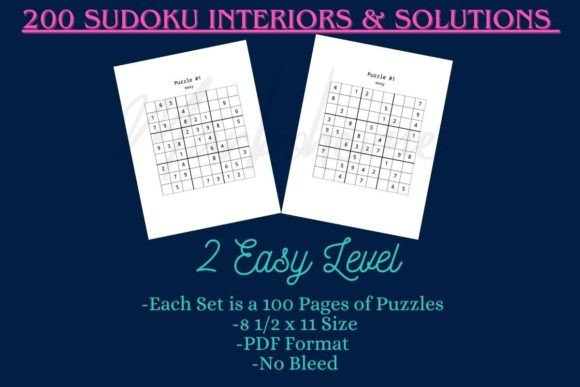
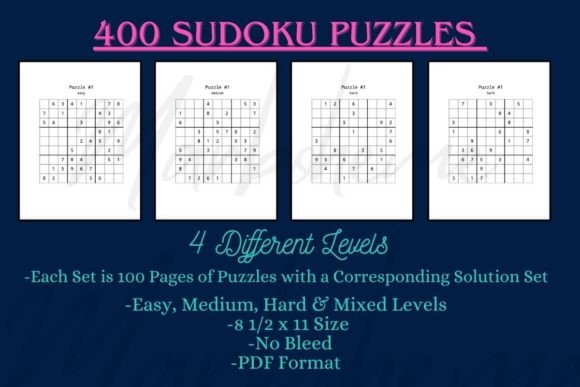
The product includes 400 standard 9x9 sudoku puzzles. Every puzzle has its own dedicated solution page, making it a complete ready-to-print book block. You won’t be flipping back to a crowded answer key at the end—each challenge is immediately followed by its solution, which improves usability whether you’re working through a printed copy or scrolling on a tablet.
The puzzles are split across four categories:
- Easy – 100 puzzles that help newcomers build confidence and scanning techniques.
- Medium – 100 puzzles that introduce more complex deduction without becoming frustrating.
- Hard – 100 grids requiring deeper lookahead and pattern recognition.
- Mixed-level – 100 puzzles drawn from all difficulties, great for variety seekers or compilation books.
The progression feels intentional. The easy puzzles are genuinely accessible—no obscure techniques needed—while the hard tier doesn’t veer into guesswork territory. That balance keeps solvers in a productive flow state, where the challenge matches their skill level without feeling repetitive. The mixed section adds an element of surprise, which many puzzle book buyers actively seek out.
Design and format choices that matter
The PDF is sized at 8.5 x 11 inches with no bleed, which is the default for many print-on-demand services. Because the design avoids elements that run to the edge of the page, your printer or KDP dashboard won’t throw warnings about trimming or margins. The grids are crisp and well-spaced, with a layout that gives your eyes room to breathe—something often overlooked in hastily assembled puzzle books.
Each puzzle page follows a consistent visual rhythm. Numbers are clearly legible, the grid lines are sharp, and there’s just enough white space for pencil notes or candidate numbers if someone prefers solving on paper. The solution pages mirror that clarity: large, easy-to-read completed grids that leave no ambiguity. This isn’t just aesthetically pleasing; it directly reduces skimming fatigue when checking answers.
For anyone who’s tried to format a puzzle book themselves, the pain points here are familiar. Auto-generated sudoku collections often spit out tiny grids, inconsistent margins, or pages that look crowded. Sudoku Book Interiors-400 Puzzles sidesteps all that. The file arrives press-ready, so you can upload it directly or drop it into your book formatting tool without adjustment.
Self-publishers and KDP creators
If you publish low-content or medium-content books on Amazon, you know the competition is fierce. Sudoku books remain a consistent category, but buyers have become pickier. They notice when puzzles look crammed, when the difficulty labeling lies, or when solutions are hard to read. Using this interior lets you skip the puzzle generation and layout grind entirely. You focus on cover design, niche positioning, and marketing—the activities that actually move copies. Instead of spending days formatting 400 puzzles, you can go from idea to live listing in under an hour.
Many new publishers underestimate how much formatting impacts customer reviews. A single complaint about “puzzles too small” can drag your rating down. With a professionally prepared interior, the likelihood of those technical complaints drops significantly. It’s a quiet trust-builder that works in the background.
Educators and cognitive fitness advocates
Sudoku isn’t just a pastime; it’s used in classrooms and adult learning centres to sharpen logical reasoning and sustain attention. Teachers sometimes build puzzle packets for early-finisher activities, and therapists incorporate them into cognitive rehabilitation routines. Having a clean, reproducible PDF with a clear difficulty ladder makes it easy to pull exactly what you need for a session. The mixed-level section is particularly handy here—you can print a single booklet that adapts to different student or client capabilities without sorting through multiple files.
Creative professionals and content creators
Bloggers, newsletter writers, and social media managers frequently use puzzles as lead magnets or engagement pieces. A travel blogger might offer a printable “airplane puzzle pack”; a productivity coach might bundle sudoku with time-management tips. Sudoku Book Interiors-400 Puzzles gives you commercial-quality content that can be repurposed ethically—just confirm the license terms, but many of these products allow you to use the interior in your own published works. It’s a versatile asset when you need something tangible to pair with digital content.
Practical ways to use the 400 puzzles
Beyond straight book publishing, the file opens up several practical avenues:
- Print-on-demand puzzle books. The most obvious path. Pair the interior with a custom cover, publish on KDP or IngramSpark, and you have a viable product live in days. Sudoku books have steady search volume, and a well-presented 400-puzzle book can establish a foothold in a competitive niche.
- Printable Etsy products. Extract sections and sell as individual downloadable puzzle packs. The easy and mixed-level sets often appeal to casual solvers who don’t want a whole book. You can create themed bundles like “100 Easy Sudoku for Beginners” or “Summer Puzzle Collection” without designing a single grid.
- Corporate wellness and event materials. Companies running mental-health weeks or team-building events sometimes hand out puzzle booklets. A branded cover with this interior makes for a cost-effective, engaging giveaway that people actually use.
- Personal brain-training routine. Many individuals treat sudoku like a daily mental warm-up. Printing a batch from the PDF and keeping it on your desk or nightstand creates a low-friction habit that doesn’t involve screen time. The four difficulty levels mean you can gradually increase challenge across weeks, tracking your improvement informally.
- Gift and care-package inserts. A few printed pages tucked into a care package for a friend, a retirement basket, or a rainy-day family activity folder add a thoughtful, interactive element. Because the pages are clean and professional, they feel like part of a purchased product rather than a hastily photocopied afterthought.
Why difficulty balance matters more than quantity
A 400-puzzle book can sound like a gimmick if the difficulty isn’t carefully calibrated. What makes this collection stand out is that it doesn’t simply stuff pages with easy grids to inflate count. The spectrum from easy to hard has been tuned. Solvability has been verified, so you won’t hit a grid with multiple solutions or a broken logic path—a surprisingly common problem in auto-generated collections that didn’t get human review.
The easy puzzles use straightforward single-candidate eliminations and basic hidden singles. The medium tier nudges solvers toward pointing pairs and box-line reductions without announcing it. Hard puzzles demand more advanced pattern recognition like X-Wings or swordfish, but remain logical and don’t require guessing. This progression is important because it respects the solver’s time. Nobody enjoys grinding through a supposedly “hard” puzzle that’s actually just a tedious exercise in brute force. The collection respects the craft of sudoku construction, and that respect translates into a better solving experience.
What to consider before you buy
The PDF is a digital download, so you’ll need a PDF viewer and a printer if you want hard copies. It’s optimized for black-and-white printing, which is exactly what you want for a puzzle book—colour would only add cost with no benefit. The 8.5 x 11 inch size is ideal for North American markets; if you’re targeting a European A4 audience, you may need to adjust slightly or confirm compatibility with your printer. Most print-on-demand platforms handle this sizing without issue, but it’s worth double-checking if you plan to publish outside the US.
If you’re drawn to sudoku variants—killer sudoku, diagonal, irregular cages—this isn’t that product. It focuses on classic 9x9 sudoku, which has broader mass-market appeal and higher search demand on retail platforms. The classic format is also easier to sell in multiples because it doesn’t confuse casual buyers with rule variations.
Another consideration is licensing. If you’re buying the interior for commercial publishing, confirm that the license permits use in books you sell. Most products like Sudoku Book Interiors-400 Puzzles are sold with a commercial-use clause specifically for KDP and similar platforms, but it’s always good practice to read the included license terms. This protects you from potential account issues down the line.
Making the most of the interior as a publisher
If you’re entering the puzzle book market, the interior file is only half the equation. Your cover design and niche selection play a huge role in discoverability. Use the interior as the backbone, then tailor your cover and title to a specific audience: “Sudoku for Stress Relief,” “Hard Sudoku for Logic Lovers,” “Large Print Easy Sudoku for Seniors,” and so on. The same interior can serve multiple niches simply by how you frame it. The mixed-level file works naturally for a general audience title, but you could also bundle only the easy and medium puzzles into a beginner-friendly edition.
Pay attention to your book’s subtitle, categories, and keywords on KDP. Terms like “puzzle book for adults,” “brain games,” and “travel size” (if you reformat) attract different buyer segments. The interior gives you the hard part; the rest is market positioning, which is where your creativity and research come in.
Bottom line: a practical, ready-made foundation
What makes Sudoku Book Interiors-400 Puzzles genuinely useful is its lack of friction. You’re not buying a collection of puzzles that still need reformatting, rescaling, or QA testing. You’re getting a finished, printable, and commercially safe block of content that does exactly what it says on the tin. For the solo publisher tired of fiddling with puzzle generators, the teacher who wants a clean reproducible set, or the individual solver who appreciates thoughtful difficulty curation, it’s a straightforward win.
The puzzles are clear, the solutions are accessible, and the learning curve feels intentional. That combination—clarity, structure, and thoughtful gradation—is harder to find than it should be. When you can drop a ready-made interior into your workflow and move directly to publishing or printing, you’re no longer spending energy on mechanics; you’re spending it on what comes next.