Choosing a Kids Vacation Journal KDP Interior: A Practical Evaluation
For many Amazon KDP publishers, the idea of creating a children's journal from scratch can feel both exciting and overwhelming. A Kids Vacation Journal KDP Interior offers a ready-to-use foundation — a pre-designed interior file that you can upload directly to Kindle Direct Publishing. This particular product includes a 100-page, 110-page, and 120-page PDF, all sized at 8.5 x 11 inches with no bleed and a crisp 300 DPI resolution. Additional editable formats like EPS, transparent PNG, and high-resolution JPG are also provided. This evaluation will help you understand what this interior offers, who it serves best, and where you might need to look elsewhere.
Understanding the Kids Vacation Journal KDP Interior
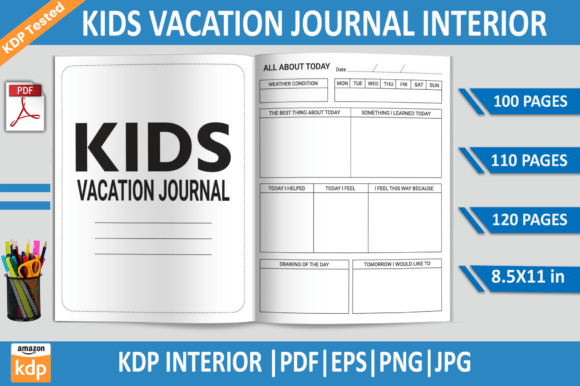
A KDP interior is essentially the inner content of a book — everything between the covers. In this case, it’s a repeatable template designed for children to record their travel experiences. The files arrive tested on Amazon KDP, meaning the trim size, margins, and overall formatting have already been checked for compliance. This interior is not a complete book; you will need to add your own cover, though the interior is ready for immediate upload after any optional personalization.
The package includes three page-count variations: 100, 110, and 120 pages. This gives you flexibility if you want to offer different editions or if your target audience expects a certain thickness. The 8.5 x 11-inch format is a common large size for kids’ activity books, providing ample space for drawing and writing. No bleed means you don’t have to worry about graphics extending to the page edge, which simplifies both design and printing. The 300 DPI quality ensures text and lines appear sharp, not pixelated or blurry, when printed.
Who Might Be Interested in This Interior?
The primary audience is low-content and medium-content book creators on Amazon KDP. If you’re a publisher building a line of children’s journals, a travel log, or a keepsake diary for family vacations, this interior could save you dozens of design hours. It may also appeal to:
- New KDP sellers who want a low-risk, tested product to learn the publishing process.
- Busy parents or educators who plan to self-publish a single journal for personal use or fundraising, and need a print-ready file quickly.
- Designers who prefer to modify an existing vector file (EPS) rather than build a layout from scratch.
Page Count Options and Size
Having three page counts pre-built allows you to experiment with perceived value. A 120-page journal feels more substantial than a 100-page version, even if the content structure is identical. The 8.5 x 11-inch size is a standard choice for children’s activity books, but it is worth checking if your target niche often uses smaller formats like 6 x 9 inches for travel convenience. The included dimensions work well if the journal is intended for use at a table or during downtime at a accommodation, rather than as a pocket companion.
No Bleed and 300 DPI
No bleed interiors are much easier to format because elements can be placed comfortably within the margins. This is especially useful if you intend to edit the files. You won’t have to worry about critical text or lines being cut off during printing. The 300 DPI resolution ensures that even when the file is viewed on a screen or printed at the full 8.5 x 11-inch size, line art, borders, and prompt text remain clean. This attention to print quality can help reduce negative customer reviews that mention blurry interiors.
Multiple File Formats
The Kids Vacation Journal KDP Interior comes with a print-ready PDF, which is the direct upload file for KDP. However, also receiving an EPS file means you can load the design into Adobe Illustrator (or another vector editor) and adjust fonts, rearrange sections, or swap out icons. The transparent PNGs are handy for placing individual elements into your own layouts, and the high-resolution JPGs can be used for previews or mockups. This format variety makes the interior more than a static template — it’s a flexible resource even if you later want to create spin-off products.
Benefits for Your Publishing Workflow
Using a pre-tested interior removes a significant amount of guesswork. First-time publishers often struggle with KDP’s margin requirements, trim size, and bleed settings. Because this interior is delivered KDP-tested, the risk of file rejection on upload drops considerably. The time saved is not just in initial design: you’ll likely spend fewer hours on revisions and troubleshooting.
Another subtle benefit is the psychological confidence that comes from starting with a proven structure. When you see a well-formatted interior, you’re less likely to second-guess spacing or font sizes. This allows you to shift your focus to marketing, cover design, and niche research — areas that often have a greater impact on sales than the interior itself, provided the interior is functional and clean.
Trade-offs and Considerations
No ready-made interior is perfect for every scenario. This product uses a specific page layout that may not suit all vacation journal concepts. For example, if your journal relies heavily on interactive maps or cut-and-glue activities, you might find the current format too rigid. While the EPS file is editable, heavy modifications require graphic design software and skill. If you lack access to Adobe Illustrator or similar tools, you are largely limited to the existing design.
Another factor is that the interior length is capped at 120 pages. For a very comprehensive journal — perhaps with daily entries for a month-long trip, activities, and photo album pages — 120 pages might feel slightly thin, especially once you account for the fact that KDP prints double-sided. You cannot easily extend the page count without the original layered source files. Also, note that you must create or source a cover separately. The interior does not include a cover template, though the trim size is standard enough that many cover designers can match it.
When This Interior Excels
This Kids Vacation Journal KDP Interior is an especially strong fit under these conditions:
- You want to publish quickly. The print-ready PDF can be uploaded within minutes of purchase, assuming you already have a cover.
- Your audience values simplicity. A clean, unfussy layout with age-appropriate prompts often outperforms an overly decorative design for younger children.
- You’re testing a niche. Instead of spending weeks designing, you can launch with this interior, gauge the market response, and then decide whether to invest in custom design.
- You appreciate versatility. The editable formats let you repurpose sections for other low-content books like a generic travel journal or a summer diary.
When You Might Want to Look Elsewhere
If your vision involves a highly thematic journal — for instance, a maritime cruise log with nautical illustrations on every page, or a camping journal with specific checklists and scavenger hunt elements — a completely custom interior might be more appropriate. The same applies if you need a different trim size. Perhaps your target market prefers a compact 6 x 9-inch book that can slide into a backpack or glove compartment; resizing an 8.5 x 11-inch interior introduces proportional challenges and is not a straightforward task.
Additionally, if you sell on platforms outside of Amazon that have different print specifications, a KDP-tested file does not guarantee compliance elsewhere. In those cases, you would need to adjust margins and file formats manually. Finally, if you plan to create an extensive series with a cohesive design language, starting with a fully custom template from the ground up might be worth the upfront investment to ensure consistency across all titles.
Practical Decision-Making Insights
Before committing to any pre-made interior, take a close look at your niche. Search Amazon for “kids vacation journal” and study the interiors shown in customer reviews or previews. Notice what page elements appear frequently: spaces for drawing, sentence starters, weather icons, packing lists. Then compare those to the interior you’re evaluating. Does it include similar sections? If not, can the EPS file be adapted without distorting the overall flow? Being objective here prevents you from releasing a product that feels out of step with reader expectations.
Consider your skill level and available tools honestly. If you can comfortably work with vector files, the editable formats add tremendous long-term value. If you cannot, value the interior primarily for its ready-to-use PDF and perhaps the PNG assets for simpler modifications. Also, factor in the page count: will 120 pages feel generous enough for a vacation that could span a week or more? Estimate the average entries per day and see if the number feels right. You can always shorten the number of pages you use, but extending is not possible.
Finally, think about your pricing strategy. A book with a larger page count and a 8.5 x 11-inch trim often justifies a higher price point than a smaller, thinner book. The no-bleed design can also reduce printing costs slightly compared to a full-bleed interior, which may improve your royalty margin.
Weighing the Overall Value
When you assess a Kids Vacation Journal KDP Interior, you’re really evaluating a combination of time savings, technical reliability, and creative flexibility. The inclusion of multiple page counts and editable file formats makes this a versatile starting point. It removes many early-stage obstacles for new publishers, while still offering growth potential for those who want to customize.
The trade-offs — mainly around design rigidity and page count limits — are manageable if your project aligns well with the existing structure. If you are entering the kids’ travel journal market for the first time, or if you want a dependable backup interior that you know will pass KDP’s review, this product deserves a close look. However, if your journal concept requires specialized content, unusual dimensions, or extremely high page counts, you may be better served by either an extended custom project or a more modular template system.
Ultimately, the right choice balances your time, your design capabilities, and the specific needs of the children and families who will use the finished book. By carefully evaluating these factors, you can decide whether this ready-to-upload interior helps you reach your publishing goals with confidence.